The Making of a Decision - Part 1
This series of posts goes over the topics described in this talk.
The other posts:
- The Making of a Decision - Part 1 - Intro & Power
- The Making of a Decision - Part 2 - Knowledge
- More coming soon
Nearly 30 years ago, I had a great opportunity that might have changed my life in terms of education and work opportunities. The decision, outside my control, didn’t go my way. My family decided that they couldn’t support it. Over time I’ve come to understand their reasoning, though it was difficult to accept when it affected my future far more than theirs. Programming helped me reclaim a sense of agency. I could create something out of nothing.
That sense of freedom and agency diminished as I moved to larger, more complex projects with bigger teams. As software systems grow, they become difficult to change, and more people are involved in making those changes. Remember:
“These decisions are a record of the power structures and the feedback loops that got it there.” -Andrew Harmel-Law
Issues with decision making are more pervasive in the bigger projects, I found again and again issues such as: strong biases for a particular decision, not validating inputs or outcomes, complex processes that promised safety but didn’t deliver and a lot more. The issues were recurring but no clear pattern emerged. People often attribute these failures to ‘politics,’ lack of technical experience, or key personnel departures. These reasons seem to be about dealing with the emotional cost of the decision rather than the underlying problem. I needed to understand more about what is happening and why. Ideally learn about ways to address some of the challenges.
As I started mapping how the people I’ve worked with (and myself) make decisions and what are the types of activities involved, I noticed that there were two key concepts that we use a lot but seem to mean different things to different people: knowledge and power.
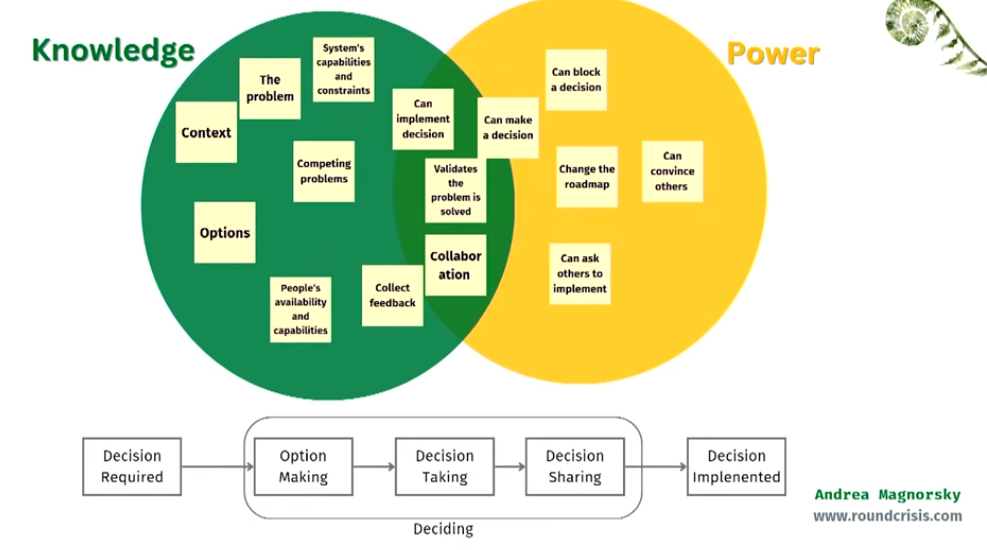
Power is uncomfortable to discuss but essential to understand: learning about power is essential to be effective, to be taken seriously and to not be taken advantage of.
There are two key definitions of power that I find useful:
Power With (Mary Parker Follett)1: “The ability to make things happen, to be a causal agent, to initiate change.”
Power Over: “The ability to make others do as you would have them do.”
Sources of Power
I found the treatment from the book “The Dawn of Everything” most complete and relatable. When transposing the ideas about sources of power from the book over current organisations, we might end up with:
Authority: In organisations, this manifests as economic coercion rather than physical force. It’s the power to fire, demote, or economically punish employees. It can manifest in access control. HR departments and security functions institutionalise this form of control, creating systems of compliance through the implied threat of economic harm.
Charisma operates through leadership appeal, inspirational vision, and personal influence networks. This manifests in leaders who can motivate and direct others through force of personality, compelling vision, or personal magnetism, regardless of their formal position in the hierarchy.
Access to Knowledge appears as information asymmetry and expertise-based authority. Senior management controls strategic information, financial data, and decision-making processes that employees cannot access. Experts wield power through specialised knowledge, whilst administrative systems create bureaucratic gatekeeping around information flow. This mirrors bureaucracy as a form of control over information as described in “The Dawn of Everything”. Knowledge hoarding can become a tool for maintaining hierarchical advantage.
For a study of Charisma see Charisma in Everyday Life: Conceptualization and Validation of the General Charisma Inventory Konstantin O. Tskhay, Rebecca Zhu, Christopher Zou, and Nicholas O. Rule University of Toronto
Laws of Power
There are many books with titles such as: “The n Laws of Power” or similar; they tend to be books about exercising influence, which can be useful. What I’m looking for when I read about the laws of power is understanding why and when power flows. So far I’ve found this to be a useful set.
- Power is dynamic. One thing you know for sure is that it will keep changing.
- Power is like water. Eric Liu’s metaphor of how power is like water and your organisation is the sponge is very memorable. More from Eric on this:
”.. power is like water. It flows all around us at all times. Sometimes it takes the liquid form of politics-in-action, a turbulent flow with crosscurrents and strong undertows. Sometimes it takes the solid form of settled law: policy is power frozen. Sometimes it is like vapor in the air, invisibly shaping the climate and our behavior in just the way beliefs or ideology or emotions do.” – You’re More Powerful than You Think. A Citizen’s Guide to Making Change Happen By Eric Liu
- Power compounds: If you have power you tend to get more power. Small exercises of power create capacity for larger ones.
I hope you enjoyed this first part of “The making of a decision”, the next post will be about knowledge. If you have any comments or questions please reach out via my social links
-
If you have never heard of Mary Parker-Follett, this is a day that can change you. Parker-Follett developed revolutionary ideas about collaborative leadership, power-sharing, and organizational dynamics decades before they became mainstream business concepts. Her central theory, that individuals and society shape each other equally, came from her work in community centers, not the boardroom. Where Taylor and Ford saw hierarchy, Follett saw networks. Read more about it in Dynamic Administration, a book that collected the works by Mary Parker-Follet ↩